
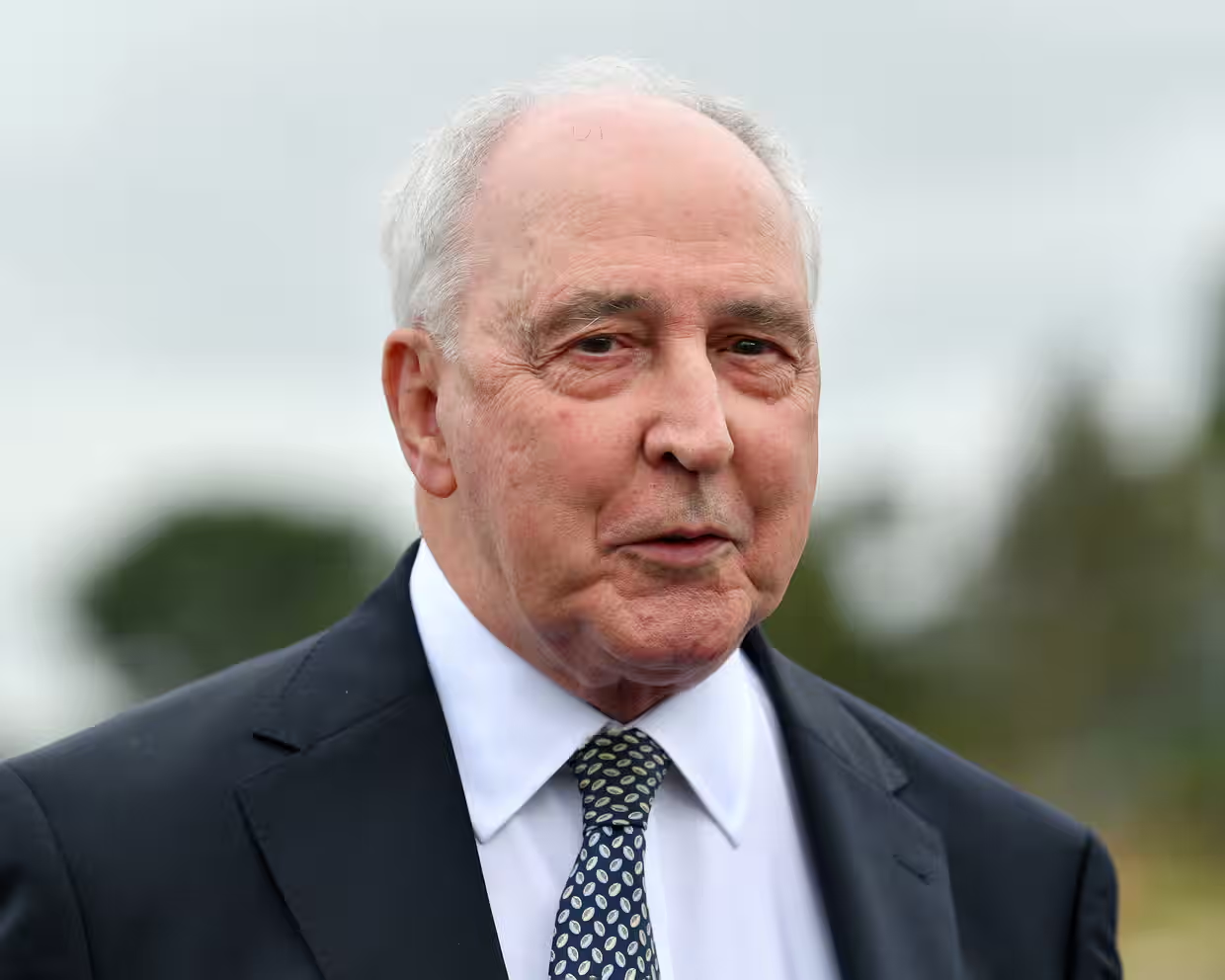
Paul Keating Claims Young Australians Will Retire With $3M in Super – Experts Say Not So Fast

A Big Promise or Wishful Thinking?
Former Australian Prime Minister Paul Keating has stirred public debate by claiming that young Australians are effectively “guaranteed” to retire with $3 million in superannuation, thanks to rising contribution rates. His comments, which aim to defend the integrity and future of Australia’s compulsory superannuation system, have sparked both support and skepticism.
Keating’s bold figure is tied to the ongoing increase in the super guarantee rate from 9.5% to 12%, a policy designed to boost retirement savings over the long term. But experts say Keating may be painting too rosy a picture, and that the $3 million claim doesn’t hold up for most Australians under closer scrutiny.
What Keating Actually Said
Speaking about the value of superannuation in securing dignity in retirement, Keating said:
“Young people today, just entering the workforce, are guaranteed to retire with $3 million in super.”
The statement implies a future where the super system delivers substantial retirement wealth—if contribution rates stay on track and investment returns remain strong.
Keating has long been a vocal defender of Australia’s superannuation model, which was introduced under his government in the 1990s. His argument: increasing contributions now will reduce pressure on the aged pension system in the future.
What the Numbers Say: Is $3 Million Realistic?
The Assumptions Behind the Claim
For someone to reach $3 million in super, several optimistic assumptions need to be met:
- Starting work at a young age, around 20–22
- Consistently earning a high full-time wage, growing over time
- Never taking extended time out of the workforce (e.g., for parenting or caregiving)
- Super contributions at 12% of salary throughout their career
- Strong investment returns, averaging around 7% annually over 40+ years
Reality Check: Not the Average Experience
Experts point out that the typical Australian will fall short of this target:
- Median earnings are significantly lower than the high salaries assumed in Keating’s model
- Many people, especially women, have interrupted work patterns or part-time roles
- Housing costs, student debt, and the casualisation of work make steady saving harder
- Market volatility means investment returns can’t be guaranteed over decades
Super Consumers Australia recently reported that even under improved contribution rates, the median retirement balance is expected to be far lower, closer to $500,000 to $800,000 for most people.
Critics Respond: Helpful Ambition or Misinformation?
Caution from Economists and Retirement Experts
- Brendan Coates, from the Grattan Institute, said the $3 million figure is “deeply unrealistic for most Australians.”
- Some critics argue that setting the bar so high risks undermining trust in the system if people fall far short of those expectations.
- Others suggest the focus should be on retirement adequacy, not maximum accumulation, as most people do not need millions to retire comfortably.
Gender and Inequality Gaps Persist
Women, in particular, face major obstacles in reaching high super balances due to:
- Pay gaps
- Unpaid caregiving roles
- Career breaks
- Higher rates of part-time work
Keating’s $3 million claim does not appear to account for these structural disparities.
Why Keating Is Making the Argument
Defending Superannuation’s Purpose
Keating’s message is ultimately about defending the long-term sustainability of the superannuation system. Critics of increasing the super guarantee argue it may lead to lower take-home pay now, especially for low-income workers.
But Keating insists that a strong super system:
- Reduces pressure on the aged pension
- Maintains living standards in retirement
- Encourages national savings and investment
- Is a social contract between generations
His $3 million figure may be more of a rhetorical benchmark than a realistic forecast for the average worker.
The Super Guarantee: Where It Stands Now
- As of July 1, 2024, the superannuation guarantee rate is 11.5%
- It will increase to 12% by July 2025, completing a gradual rise over several years
- Contributions are compulsory for employers, based on an employee’s ordinary earnings
- The system currently holds over $3.7 trillion in total assets—one of the world’s largest retirement savings pools
Hopeful Vision or Overpromise?
Paul Keating’s vision of young Australians retiring with $3 million in super is an ambitious ideal—one that reflects what the system could deliver under perfect conditions. But for most Australians, especially those on average or lower incomes, the real figure will likely fall short.
Still, the debate Keating has reignited is an important one: what should Australians expect from their super? And how do we make the system fairer and more effective—especially for the millions who won’t reach millionaire status in retirement?

