
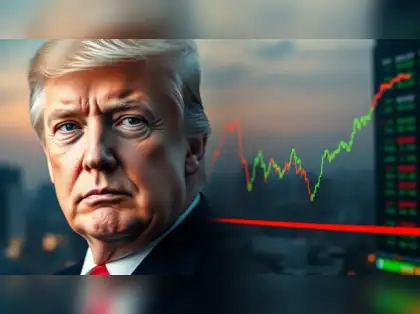

The global markets are reeling after the full impact of U.S. President Donald Trump’s tariffs took effect, leading to massive losses on the Australian Stock Exchange (ASX). Nearly $50 billion was wiped off the market as the tariffs, aimed at U.S. imports, triggered a dramatic sell-off across Asia. As the U.S.-China trade war continues to heat up, investors are nervous about what comes next. But how exactly did this happen, and what does it mean for your investments? Let’s break it down.
Trump’s Tariffs Hit the Markets Hard
The day started with hope for Australian stocks, but by the end of the session, the All Ordinaries index had fallen by 1.9%. This sharp decline came as Asian markets reacted to the tariffs imposed by the Trump administration. The steep tariffs, which had been looming for months, officially took effect, and investors were left to deal with the fallout.
The reason behind the market plunge? The tariffs introduced by the U.S. had been expected for some time, but when last-minute deals failed to materialize, it became clear that a resolution was nowhere in sight. The full force of these tariffs started to show, and stock markets across the globe were jolted as a result.
What Exactly Are Trump’s Tariffs and Why Do They Matter?
For those unfamiliar, tariffs are taxes placed on goods imported from other countries. The U.S. government, under Donald Trump, has used tariffs as a weapon in its trade dispute with China, among other nations. The idea is to make foreign goods more expensive in the U.S., which theoretically encourages consumers to buy American-made products instead.
However, the effect of these tariffs is far-reaching. Not only do they increase the cost of goods in the U.S., but they also disrupt global trade flows, causing uncertainty in stock markets. When tariffs increase on goods being imported into the U.S., it can cause a ripple effect through international markets, particularly in countries that rely on exporting goods to the U.S. Like Australia, for example.
Australian Market Reacts to U.S. Tariffs: What Happened?
When the U.S. tariffs officially kicked in, Australian shares were hit hard. The All Ordinaries, which is the benchmark stock market index for Australia, dropped by 1.9%, wiping out almost all the gains from the previous day. This sharp decline was directly tied to the announcement of new tariffs that affected global supply chains and investor confidence.
For Australian businesses, many of which are exporters, the new tariffs make it more expensive to sell products in the U.S. This uncertainty causes investors to pull back from stocks, leading to a drop in share prices. Markets don’t like uncertainty, and when tariffs rise, businesses face the possibility of lower profits, which is reflected in their stock prices.
Asian Markets Feel the Pinch, Too
It wasn’t just Australia that felt the heat. Asian markets, too, reacted strongly to the news of the U.S. tariffs. For instance, China’s Shanghai Composite index rose by 1.3%, signaling that Chinese stocks were somewhat resilient in the face of the new tariffs. But in Hong Kong, the Hang Seng index saw a modest 0.4% increase, as investors remained cautious amid the ongoing trade tensions.
The trade war has made it clear that no one is immune to the impact of U.S. tariffs. Even though China and other Asian nations might not be directly affected by the tariffs on U.S. imports, the ripple effects still hurt their economies, leading to volatility in stock markets across the region.
China’s Stance: Firm Opposition to U.S. Tariffs
China has been outspoken in its opposition to the tariffs imposed by the U.S. government. As the tariffs took effect, China reiterated its commitment to standing up to U.S. economic pressures. The Chinese government has accused the U.S. of “abusing” tariffs as a tool to gain trade leverage, and China has vowed to respond with its own set of tariffs and trade policies.
For global markets, this ongoing back-and-forth only adds to the uncertainty. If China and the U.S. continue to engage in this tit-for-tat trade war, it could lead to more market volatility. The global economy, already struggling with challenges like inflation and supply chain issues, could be further destabilized by the escalating trade conflict.
The Bigger Picture: What Does This Mean for Global Markets?
The U.S. tariffs are part of a broader strategy by the Trump administration to reshape the global trading system. While the goal is to bring more jobs and manufacturing back to the U.S., the ripple effects are being felt worldwide. For Australian businesses and investors, the immediate consequence is a dip in stock prices. But for global markets, the longer-term impact could be far-reaching.
If the trade war continues, it could lead to slower global economic growth. Businesses around the world may have to adjust their supply chains to deal with the new tariffs, and consumers could face higher prices for goods. The global economic landscape is becoming more uncertain, and markets are responding with caution.
What’s Next? Can the Market Recover?
The key question now is whether the markets will stabilize or continue to decline. The drop in Australian shares represents just a snapshot of the market’s reaction to the new tariffs, but it’s too early to say whether the damage will be long-term. Some experts believe that markets may recover as traders adjust to the new economic realities. Others warn that the damage from the tariffs could linger, especially if the U.S. and China fail to reach a trade agreement soon.
For investors, the uncertainty surrounding the tariffs means more volatility in the short term. If the U.S. and China continue their trade standoff, expect to see more fluctuations in global stock markets. But if talks lead to a breakthrough, there could be a bounce-back for markets that have been hurt by the trade war.
A Wake-Up Call for Global Markets
The impact of Trump’s tariffs has been felt far and wide, with Australian markets losing nearly $50 billion as a result. The situation has added to global economic uncertainty, and it’s clear that investors are worried about what comes next. The U.S.-China trade war is far from over, and it could continue to shake markets in the months to come.
As the dust settles, global markets will need to adapt to the shifting landscape of international trade. Whether the tariffs lead to long-term disruptions or short-term volatility remains to be seen. But for now, one thing is certain—trade tensions are making the global economy more unpredictable than ever before.

