
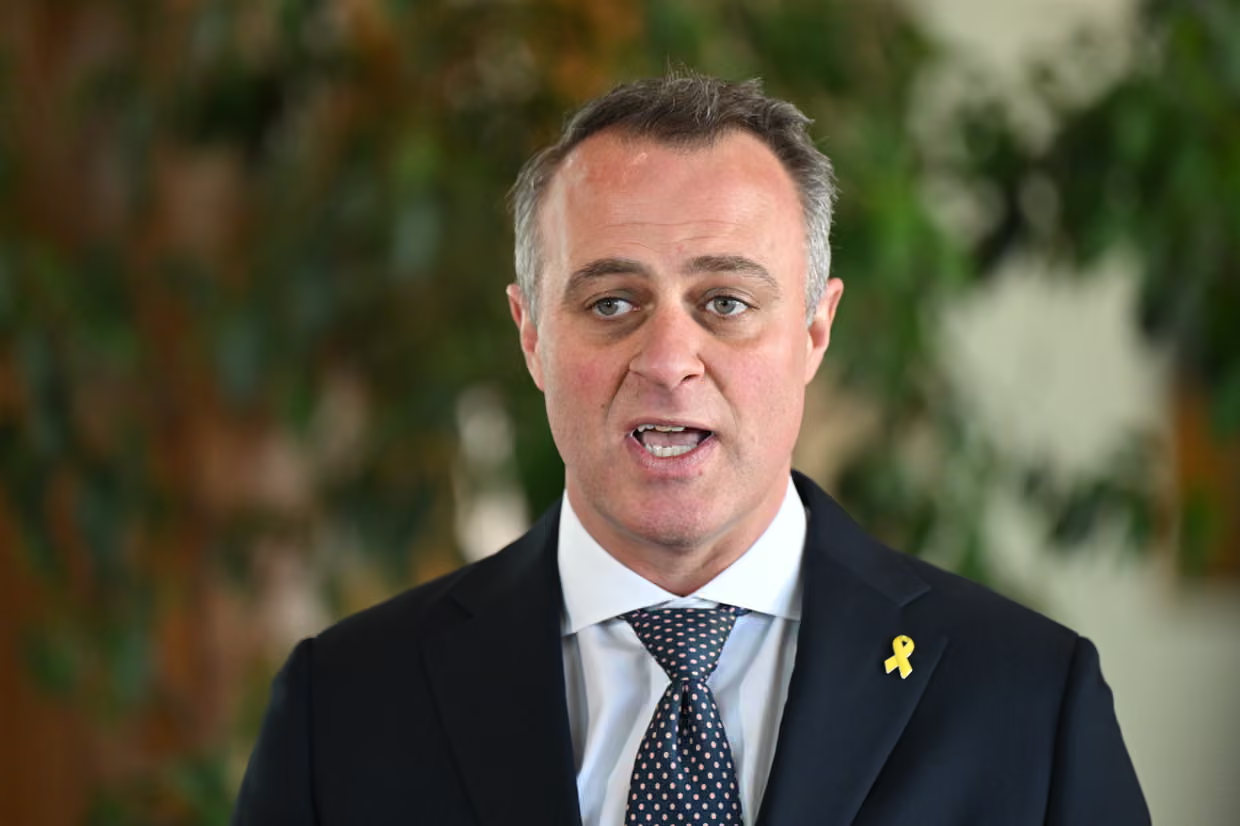

A Rare Move by a Politician
Liberal MP Tim Wilson has attracted attention after it emerged that he holds a long-standing bet against Australia’s sharemarket. His register of interests, released in August following his narrow election win in Goldstein, reveals that Wilson invested in a leveraged financial product designed to profit when the benchmark ASX 200 index falls.
It is unusual for a sitting politician to place such a wager. Typically, investments aligned with market growth are seen as an indication of confidence in the economy. Wilson’s position, by contrast, could be perceived as expecting or even benefiting from a downturn—a politically sensitive stance for an elected representative.
What Is Wilson’s Investment?
The product Wilson holds is the BetaShares Australian Equities Strong Bear Complex, an inverse exchange traded fund (ETF) that uses leverage to amplify gains and losses. For every 1% decline in the ASX 200, the investment could gain up to 2.75%. However, this magnification works both ways—when the market rises, the losses accumulate just as quickly.
Inverse ETFs are often used by investors as a hedge during periods of uncertainty. They are designed to provide returns opposite to market movements but come with high risk and significant volatility. Analysts have described them as complex financial instruments, suitable only for those with a strong appetite for risk and a deep understanding of the market.
Wilson’s Reasoning
A spokesperson for Wilson, who serves as the shadow minister for small business, explained that the MP originally purchased the product in early 2020, at the onset of the Covid-19 pandemic. At that time, uncertainty around the global economy and market fluctuations made such hedging strategies popular among investors seeking protection.
However, the spokesperson added that Wilson has since chosen to maintain the position due to what he views as the Albanese government’s “poor economic policies.” The suggestion is that ongoing economic instability has, in Wilson’s view, justified keeping the investment alive.
The spokesperson declined to disclose the exact size of Wilson’s position, only stating that it is “less than the value of the subsidies the Teals voted to give to coal and gas companies.” The comment highlights the politically charged nature of the debate and the broader critique of government support for fossil fuel industries.
A Poor Investment So Far
Financial analysts and market experts have pointed out that Wilson’s bet has not paid off. Since early 2020, the Australian sharemarket has experienced periods of recovery and resilience despite global disruptions. The ASX 200 has rebounded strongly from pandemic lows, supported by fiscal stimulus and sustained investor optimism.
Given this environment, inverse ETFs like the one Wilson holds have underperformed, leading to mounting losses over the years. Experts warn that prolonged holding of leveraged inverse products can be particularly damaging because of daily compounding effects and rising market trends.
One market strategist commented that while hedging during the initial phase of the pandemic may have been reasonable, retaining the position long after conditions stabilised amounts to speculation rather than prudent risk management.
The Broader Political Context
Wilson’s investment strategy raises questions about how personal financial interests intersect with public responsibilities. Voters may wonder whether an MP betting against the economy aligns with the duty to support national prosperity and stability.
This revelation comes at a time when politicians are under increased scrutiny for their financial disclosures and potential conflicts of interest. Public trust hinges not only on policies but also on perceptions of integrity and alignment with constituents’ interests.
Yet Wilson’s defenders argue that using financial tools like inverse ETFs is a legitimate strategy for managing risk, especially in uncertain times. They also point to the broader political narrative, framing the investment as a response to government policy rather than a cynical attempt to profit from economic decline.
What Comes Next?
It remains to be seen whether this revelation will fuel debate within Parliament or among the electorate. As financial literacy grows and investment products become more complex, such disclosures are likely to prompt deeper discussions about transparency and ethical considerations.
For now, Wilson’s situation serves as a reminder that investment choices—even by public figures—can carry political implications. The unfolding conversation around his bet against the sharemarket reflects broader concerns about how economic uncertainty, policy criticism, and personal finance intersect in contemporary politics.
Tim Wilson’s long-held investment against the Australian sharemarket has cost him significantly amid a recovering economy. While his rationale points to pandemic-related risk management and dissatisfaction with government policies, the decision raises eyebrows about how financial strategies align with public service responsibilities. As debates around economic policy, political integrity, and market volatility continue, this episode underscores the complexities facing politicians in balancing personal investments with public expectations.