
ANU Halts Forced Job Cuts but Restructure Continues; Julie Bishop Retains Leadership Role

The Australian National University (ANU) has confirmed it will no longer proceed with forced job cuts as part of its ongoing restructure, though the process of reshaping the institution will continue. Interim vice-chancellor Professor Rebekah Brown made the announcement during an all-staff town hall on Thursday morning, offering a rare moment of relief for staff after months of uncertainty.
Brown, who became visibly emotional during her address, acknowledged the stress and anxiety staff had endured since the restructure, dubbed Renew ANU, was first unveiled. She confirmed that a higher-than-expected number of voluntary redundancies had prevented additional forced job losses. “There will be no more involuntary redundancies as part of Renew ANU,” she said. “We are still in the process of realignment, but today I can say that about 100 jobs that were at risk have been saved.”
Since the program began 12 months ago, at least 399 staff members have opted for voluntary redundancy. Brown noted that while the reduction in workforce was substantial, the university was “deeply mindful” of balancing financial realities with the wellbeing of its academic and professional community.
The ANU has faced growing financial challenges over the past few years, exacerbated by lower international student enrolments and increasing operating costs. The university leadership has argued that structural reform is necessary to ensure long-term sustainability, though the plan has been met with fierce criticism from staff unions and academics who say it undermines ANU’s reputation as a leading research and teaching institution.
One of the most controversial aspects of the restructure has been its impact on specific departments and centres. The future of the ANU School of Music remains unclear, with staff and students expressing concern that the program will be downsized or lose its prominence within the university. Similarly, the uncertainty surrounding the Australian National Dictionary Centre had sparked widespread alarm, given its role in documenting and preserving Australian English.
However, the dictionary centre received a reprieve earlier this week when it was revealed that an anonymous donor had stepped in to secure its future. The centre, which has produced influential works such as the Australian National Dictionary, had been facing potential funding cuts that could have limited its operations. The donation has been hailed as a lifeline, safeguarding an institution that plays a unique cultural role in the country.
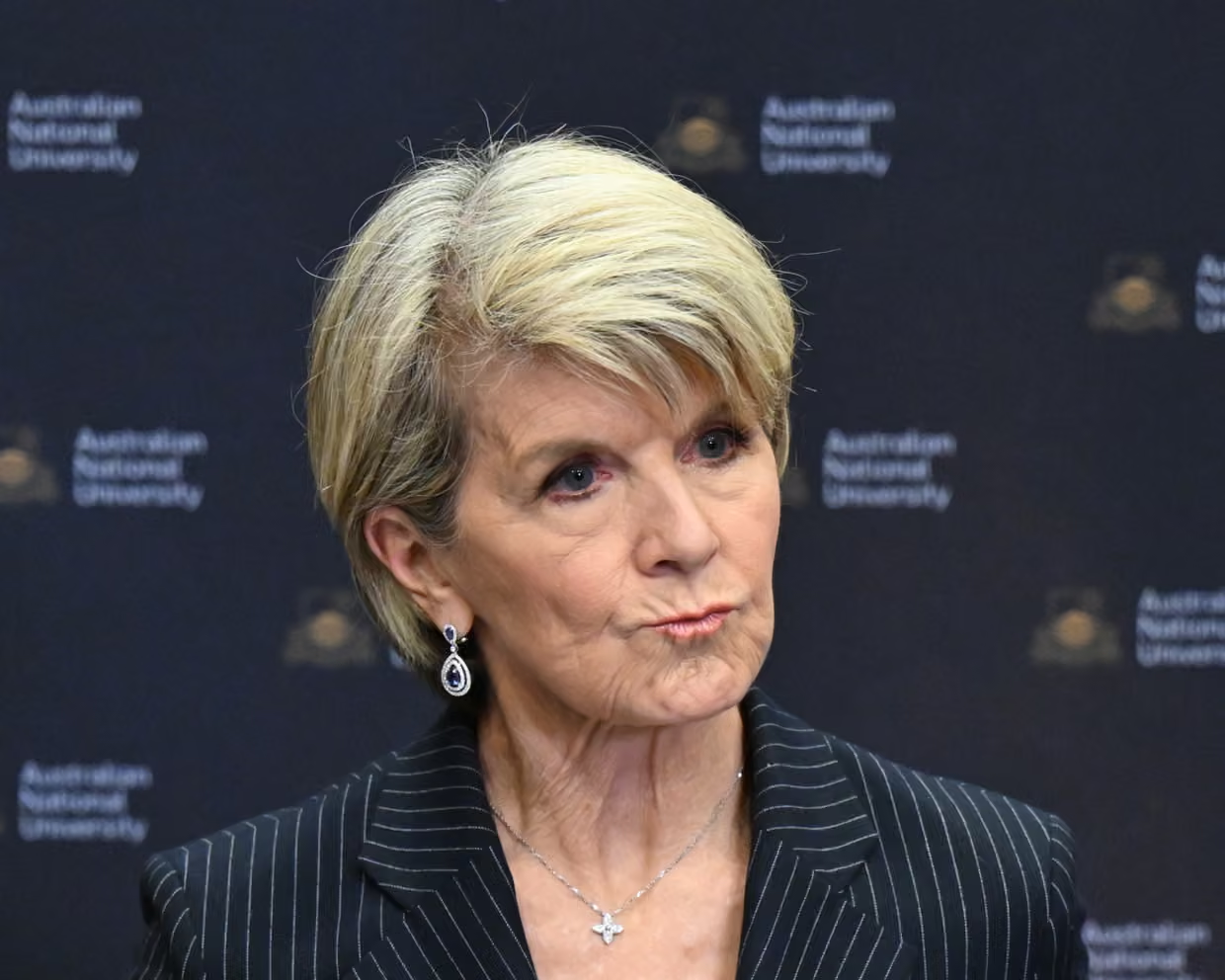
Julie Bishop, who was appointed chancellor of ANU in 2020, will continue in her leadership role despite speculation that the restructuring process might prompt changes in governance. Bishop’s presence has been a source of debate, with some praising her advocacy for higher education and global engagement, while others have criticised her close ties to government and corporate sectors. For now, her continued leadership signals continuity as the university navigates this turbulent chapter.
Staff and student representatives remain cautious despite the reprieve on forced job cuts. The National Tertiary Education Union (NTEU) welcomed the announcement but warned that significant challenges remain. “We are pleased the university has listened to staff concerns and abandoned involuntary redundancies, but this does not erase the impact of nearly 400 job losses in the past year,” said an NTEU spokesperson. “We also remain deeply concerned about the future of programs like music, which are integral to the cultural life of the university.”
Students have also voiced unease about how the restructuring might affect the quality of education. With fewer staff members across faculties, many worry about larger class sizes, reduced course offerings, and diminished access to academic support. “It’s not just about staff numbers, it’s about what kind of university ANU wants to be,” said one undergraduate student. “We want to be proud of our institution, not see it stripped back to a corporate model.”
Despite the criticism, Professor Brown emphasised that the reforms were designed to position ANU for the future. She argued that maintaining financial stability was essential to preserving the university’s global standing and research capabilities. “We cannot be complacent,” she said. “Renew ANU is about ensuring we remain a world-class institution, resilient to the challenges ahead.”
ANU has consistently ranked as one of Australia’s top universities, with a strong reputation for research output and international collaboration. Yet, like many universities across the country, it has grappled with the financial shockwaves of the COVID-19 pandemic, which severely disrupted international student revenue streams. While some institutions have since bounced back, ANU continues to face pressure to adapt to a more uncertain funding environment.
The coming months will be crucial as the university finalises its restructuring plans and outlines the long-term future of its colleges and centres. For now, staff can take some comfort in the knowledge that forced job cuts are off the table, though the broader transformation of ANU remains underway.
For the Australian higher education sector, the ANU story serves as a microcosm of the challenges universities face—balancing financial sustainability, academic integrity, and the wellbeing of staff and students. Whether the decisions made under Renew ANU ultimately strengthen or weaken the institution will be closely watched, both in Canberra and across the country.

