
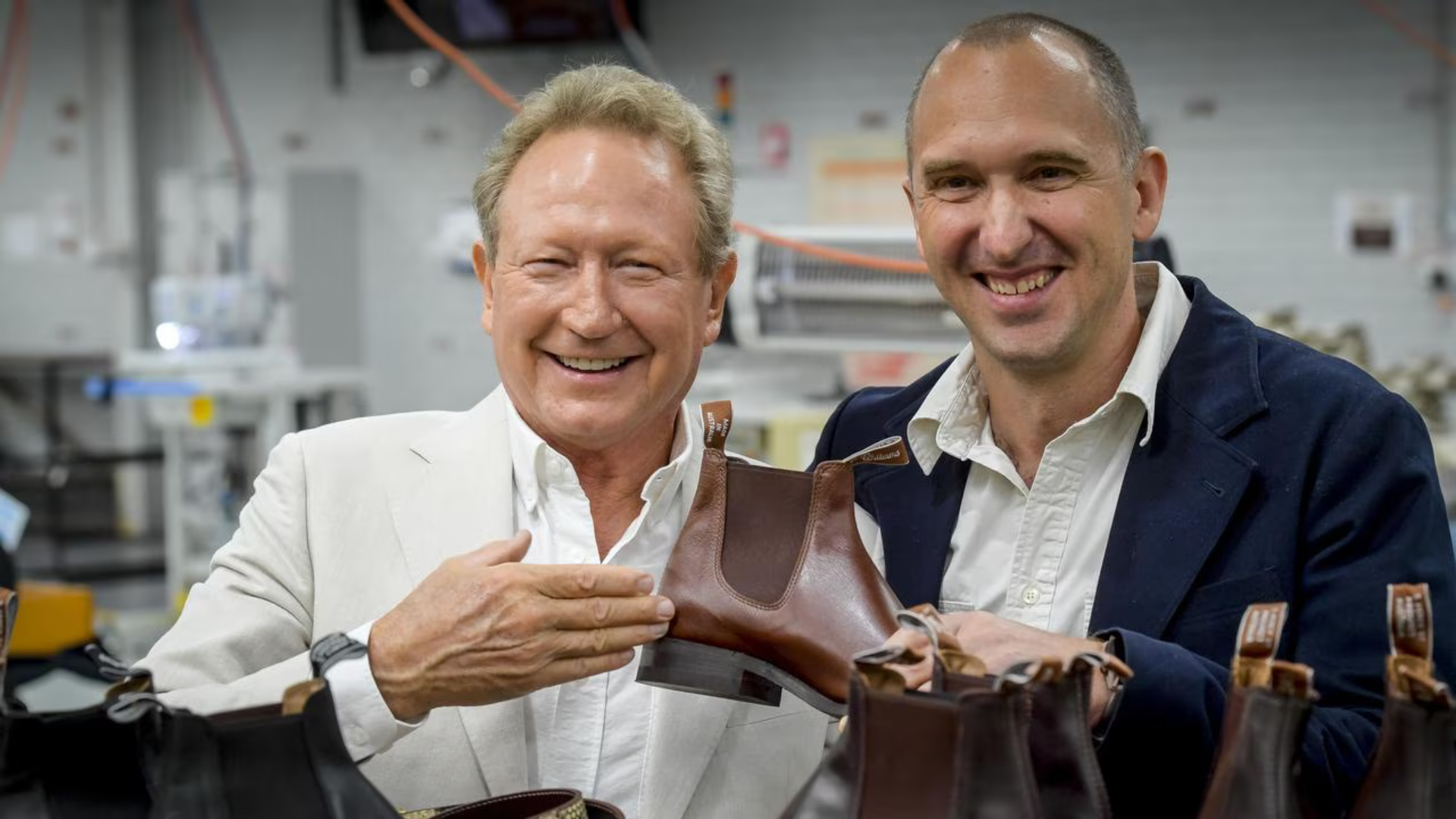

Billionaire business leader and mining tycoon Andrew Forrest has again taken himself to the forefront of Australia’s industrial debate, this time with a firm call to reinvigorate and reinvest in Australia’s manufacturing base. At his visit to the Adelaide factory of RM Williams, Forrest underscored the pressing need for Australia to re-establish its local production capacity, develop sustainable industries by innovation, and regain its world-leading status in value-added manufacturing.
The high-profile visit represented the growth of RM Williams’ world-class manufacturing facility, denoting renewed confidence in Australian-made products. Forrest, whose private investment entity Tattarang purchased the legendary heritage brand in 2020, underscored that manufacturing is not only an economic imperative, but a moral and strategic imperative for the future of the nation.
“Australia must stop exporting jobs and start exporting finished products again,” Forrest said. “We have the talent, resources, and creativity — what we’ve lacked is the belief that we can compete globally. That ends now.”
Forrest’s words are made against the backdrop of increased controversy over the country’s heavy dependence on imported products and foreign manufacture. The mining magnate, whose interests in Fortescue Metals Group (FMG) and Fortescue Future Industries (FFI) have made him a household name, has long been an advocate of diversifying the economic base of Australia away from raw material exports. His current campaign reiterates that vision, linking it directly to the formation of high-quality employment, technological development, and responsible industrial growth.
The RM Williams expansion is being considered a symbolic case study of what a “Made in Australia” renaissance would be. Once at the point of collapse, the brand’s revival under Forrest’s leadership proves that legacy companies can prosper if grounded in purpose-driven business models. RM Williams exports to over 15 countries today and is growing its adoption of locally sourced materials, all while keeping traditional craftsmanship at its Adelaide workshops.
Forrest complimented RM Williams’ staff on upholding Australia’s manufacturing culture and craftsmanship. “Each boot that is made here contains not only leather and thread — it contains the history of Australia,” he said. “This proves that Australian hands can make world-class products and that manufacturing can once more become part of national pride.”
Aside from clothes, Forrest’s general message centered on making Australia more industrialized using green power and higher-end manufacturing. He urged policymakers and business leaders to act now as international markets move towards cleaner technologies and supply chain resilience. “We have the minerals, the energy, and the innovation to be a renewable manufacturing superpower,” Forrest said. “If we act boldly, we can create thousands of new jobs and secure our economic independence.”
Industry experts and economists have seconded Forrest’s alarm, pointing out that Australia’s manufacturing industry has declined to below 6% of GDP from as high as nearly 30% in the 1970s. High domestic costs, accompanied by the growth of offshore manufacturing, have undermined the ability of local industry. Increased geopolitical tensions, supply chain disruptions, and a new consumer demand for goods made in Australia have, however, turned attention once more towards the local industry.
Forrest’s call for manufacturing has joined up with his broader campaign for green hydrogen investment in Fortescue. He contends the same principles of sustainability, innovation, and independence can drive the manufacturing renaissance. His goal is to have Australia make solar panels, batteries, electric machinery, and hydrogen infrastructure locally instead of importing them.
Political figures have received Forrest’s comments, viewing them both as a challenge and an opportunity. South Australian Premier Peter Malinauskas endorsed Forrest’s ongoing investment in the state, adding local manufacturing “isn’t just about economics — it’s about identity and resilience.”
At the same time, business councils have called on federal and state governments to work with private industry to develop a national manufacturing strategy aimed at innovation hubs, vocational training, and incentives for domestic production.
Forrest’s message has special resonance because of his history of taking innovative ideas and making them work — from constructing one of the world’s largest iron ore dynasties to leading the way in green energy developments. His dream of a “Made in Australia” renaissance combines national pride and hard-headed economics, contending that sustainable manufacturing and profitability can go hand in hand.
“We can produce the world’s best boots, the cleanest energy, and the smartest machines — right here,” Forrest summarized. “The future of Australian manufacturing does not rest on what we say, but on what we build.”
With the new global economy reshaping value chains in the wake of the pandemic, Forrest’s call to action is echoed outside RM Williams. It highlights a movement of increasing interest among Australian founders and CEOs who are recognizing local manufacturing as the future of innovation, employment, and national resilience and not nostalgia.

